Tuesday, November 17, 2015

So you are thinking about a job...

Many of you are starting to think about jobs in library and information science. Others are considering jobs in information science and associated fields. It's really important to build a network of colleagues and mentors who can help you find a position, write letters of recommendation, and introduce you to others.
 
  • Build a network. Think about your social media persona. Lock down your Facebook page and flesh out LinkedIn. Build a positive, work oriented social media presence on all social media sites. 
  • Look at job ads. What skills are prospective employers looking for? What skills can you emphasize? What do you need to learn?
  • Get some practical, hands-on experience at a cultural institution. Build a positive working relationship with your colleagues and supervisors. Think about this position as an entry into the profession. 
  • Brush up your writing skills. Write reviews, memos, letters, articles. Polish your spelling, grammar, sentence structure, and writing skills. 
  • Read widely. Read the newspaper or news feeds. Read reviews of current fiction, non-fiction, literature, current events. Read a few books. Haunt the bookstores looking at flyleaves and blurbs.
 
See what types of jobs are available through LAC Group https://lac-group.com/ and sign up for their blog.
​Follow HLS (Hack Library School) ​http://www.hacklibraryschool.com to see what other students on the east coast are talking about in terms of jobs and careers.

Attend local meetings for Georgia archivists, librarians, paraprofessionals, special librarians. See if there's a local or regional ASIS&T or SLA group. Attend their meetings. Talk about your job, your career, and ask them about jobs and career advice.
Schedule some informational interviews asking other professionals for their advice.

Librarianship is all about networking. Talk to people and see what's out there. Don't be afraid to look outside traditional librarianship for jobs.

Thursday, September 3, 2015

Blogs for LIS students and professionals

As I start to think about the Fall semester (2015), I wonder how to introduce my Foundations of LIS students to the profession. What words of wisdom can I share and how will they learn about the amazing world of Libraries, Archives, Museums, Historical Societies and more? 

I've come to realize that not only is it impossible for me to stay current, but that what I understand and know is radically different from what my students need to know. To that end, I've started following some amazing blogs that provide insight into what LIS students are learning and struggling with, or what they need to know when they graduate. 

My favorite blog, hands down, is Hack Library School HLS http://hacklibraryschool.com/.
This blog is written by a cadre of students in various LIS / IS programs. They describe what they are learning in the classroom, online, in practicum and internship programs, and in real life. As a professor and a long-time librarian, a very analog librarian, I learn a lot from the students who take the time to write something every day. Today, I was reminded that LIS students need a combination of theory and practice. http://hacklibraryschool.com/2015/08/10/theory-matters-constructing-a-personal-philosophy-of-librarianship/ It should be balance. Not all one or the other. As a practicing librarian, researcher, and historian, I know that LIS students have to know how to do research, answer questions at a reference desk, parse questions, and search the web. They also need to know how catalogs and databases work. Do we all have to know how the bits and bytes move from place to place? No, but a basic idea is good. Do we all need to know every MARC tag or how the catalogs communicate with one another using Z39 standards? Again, No! but we do need to have a basic idea about connectivity, interoperability, and, yes, discoverability. The rest, the really techy stuff, I'll leave to my students.

The other blog I read regularly is the LAC Group Blog http://lac-group.com/ A recent posting included advice for Job Seekers. http://lac-group.com/blog/2015/05/14/lac-group-publishes-advice-for-job-seekers/
If you are looking for a job, what skills do you need? This head-hunting group will fill you in.

There are other blogs of interest? You bet. I'll find some more and post them here. In the meantime, explore these blogs and let me know what you think.

Wednesday, January 14, 2015

Librarians Know a little about everything

NPR's article "Before The Internet, Librarians Would 'Answer Everything' — And Still Do" (Dec 28, 2014):  http://www.npr.org/2014/12/28/373268931/before-the-internet-librarians-would-answer-everything-and-still-do  is definitely true. As librarians, you need to stay intellectually active, learn new things all the time, and be open to new experiences.

After listening to NPR's interview, do you think that the mantra is true?
What did you learn today?


Monday, September 22, 2014

In Praise of Slow Reading

In our efforts to absorb information as quickly as it comes at us, we tend to skim, skip, glance, and peruse articles and books rather than sit and read them. All our gadgets, facebook pages, news feeds and twitter feeds do is provide snippets of information, tantalizing bits of news and current events. In the end, we know a little bit about everything. "Wait" you say, "that's what librarians do, they know a little about everything. What's so bad about all the skimming and quick reads?" Well, I must confess I too dip and skim, but that's not reading, it's not absorbing information, facts, and provides no time for wrestling with the essence of an article. You must slow down and read deeply.

There are two terms used somewhat interchangeably "Slow Reading" and "Deep Reading". They refer to the concept of taking your time, reading and thinking about what is in front of you. Slow and deep reading provides time to absorb and analyze the information, to hear the words within your head and contemplate upon their meanings. Slow reading means ruminating, fixating, and often re-reading again and again until you 'get it' and actually learn what you are studying. Here's a nice definition of the deep reading http://grammar.about.com/od/d/g/Deep-Reading.htm Scroll below the definition for some quotes in context.

Jeanne Whalen's article "Read Slowly to Benefit Your Brain and Cut Stress: At Least 30 Minutes of Uninterrupted Reading With a Book or E-Book Helps." Wall Street Journal  (Sept 16, 2014): http://online.wsj.com/articles/read-slowly-to-benefit-your-brain-and-cut-stress-1410823086 promotes reading without distraction for long periods of time. There are some tests and quizzes to determine the speed at which you read and absorb information. Try them out. See how well you do. 

In terms of school, you need to read in uninterrupted chunks of time, in a non-distracting place. Not in front of the TV or computer screen, unless of course you are reading on that screen. Read without the distraction of facebook, e-mail, and phone. Take your time. Think about the concepts you are learning, test the ideas and techniques against what you already know, apply the techniques to the exercises and subjects you are studying. 

Slow and deep reading is important for absorbing what you read and for enhancing your long term memory. Try it and let me know what you think.

===

Here are some other articles that talk about deep or slow reading:

Coleman, John. "For Those Who Want to Lead, Read"
Harvard Business Review (Aug 15, 2012): http://blogs.hbr.org/2012/08/for-those-who-want-to-lead-rea/ 

"Defining "Deep Reading" and "Text-Dependent Questions" Turn On Your Brain blog (March 29, 2012): http://turnonyourbrain.wordpress.com/2012/03/29/defining-deep-reading-and-text-dependent-questions/ This article has a nice video about the subject.

Carr, Nicholas. "The Death of Deep Reading." BigThink  (April 20, 2013): http://bigthink.com/in-their-own-words/the-death-of-deep-reading

"Why Johnny Can't "Deep" Read." NPR (April 21, 2010)  http://www.npr.org/templates/story/story.php?storyId=129348373

Monday, September 8, 2014

Learn Something New Every Day

You all know my mantra for librarians is to learn something new every day, with every reference interaction, with every project. How do we do that? By keeping an open mind, by not tuning out when answering reference questions, particularly repetitive ones, by thinking "outside the box." I once asked a colleague how he could stand doing repetitive research, particularly after 40 years in the same field. He said, "There's always something new to learn from the encounter, from the research." I took that attitude to heart and starting looking beyond the repetitive projects to understand "why." I began to really understand how the records worked, how the information was really arranged. I went beyond practice to understand the theory, the rationale behind the ideas and routines. It's made me an expert in various types of records. So the next time, you think something is routine, (other than directions to the restroom or elevator) think about how or why the database works in a particular way, why the information is arranged just so, or why you always have to ask for the information twice.

The New York Times has a great blog / service that can help you learn something new every day and stay current. It's their Learning Network. While the website is geared for K-12 teachers, librarians can learn a thing or two from it. Here's the link to the NYT Learning Network "How to Use Our Blog" page http://nyti.ms/1q72sTI . I'm intrigued by the literacy skills. The piece is entitled "I Hate These Word Crimes" http://youtu.be/8Gv0H-vPoDc

 What have you learned today?

Tuesday, September 2, 2014

A few books, a few new facts

As the semester begins, we'll be learning a little bit about librarianship. You know that's what librarians and archivists know, a little bit about everything, or almost everything, and, more importantly, where to find what someone else is looking for. 

That notion brings me to my find of the day, Harlequin, yes Harlequin Books has a new publication Let’s Get Lost http://harlequinforlibraries.com/2014/08/introducing-the-ultimate-lets-get-lost-educator-librarian-and-book-club-guide/  At first I thought it was promoting the idea of 'getting lost in a good book', but it's actually a guide to a book about traveling and discovering new things along the way. While I'd prefer the first, I'll take the second because you can always learn something new along the way, on the journey to somewhere else.

So as you travel up and down the highway on your way to class, think about who you meet, the new things you are learning, and try not to get too lost along the way.

Tuesday, August 26, 2014

Librarians as Knowledge Workers

It should not come as a surprise that Librarians are Knowledge Workers. We help individuals find the information they seek. We provide assistance as others seek to increase their knowledge of a subject, be it a period in history, the species or name for a flower, or the definition of a word. Part of what we do is work with others to navigate the all too complex databases designed by librarians or companies. We listen to questions and research problems and help our customers or patrons or users (whatever name you select) to work out a research strategy that will help them obtain the information and knowledge they seek. As the knowledge seeker develops skills for ferreting out information, so the librarian or knowledge worker must learn about new resources and techniques. 

Paula Krebs in her post "Why You Should Talk to the Librarians" https://chroniclevitae.com/news/673-why-you-should-talk-to-the-librarians?cid=VTEVPMSED1 notes that librarians know the most recent sources in a subject area, along with current research strategies and resources. The librarian will share his/her knowledge with researchers and students of all ages. All the researcher has to do is ask.

What's our job as librarians, archivists, and knowledge workers? To learn the new resources and reference tools, to be curious about subject areas we know little or nothing about, to discover new tools and learn how they work. Most of all, we need to follow one of our profession's matra, "to know a little bit about everything." After all, for knowledge workers, information scientists, librarians and archivists, it's less important that we KNOW something, than that we know WHERE to look for the information.

So go off and learn something new today. See where you quest for knowledge takes you. Enjoy the journey.

Write a little every day

As librarians, grad students, and professionals, you'll be asked to write memos, reports, press-releases, news, reviews, and so much more. That means you should practice your writing skills regularly. Hone your knowledge of sentence construction, spelling, and grammar. Learn to proof-read your own work and that of others.

If you take a tenure track, academic librarianship job, you'll be writing articles for journals, and even books, to get that desired tenure and promotion first to associate professor then full. Again, that means writing and more writing.

No matter the position, you'll need to be able to craft a memo, letter, review, and report so that it is readable and to the point. The written piece should be in the correct style; academic, formal, or informal, formulaic or free-form. Once you master the writing style of your current position or institutions, you'll move on and have to master a new style, a new set of guidelines and expectations.

Gregory Semenza writing for the Chronicle https://chroniclevitae.com/news/616-the-value-of-10-minutes-writing-advice-for-the-time-less-academic has some sage advice. Write for 10-15 minutes every day. In that short time, you'll get something started, honed, or even finished. In the short block of time, you can focus on your topic and stay focused. 


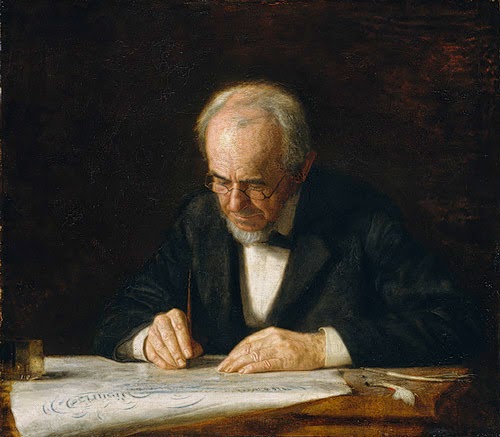
 Thomas Eakins, The Writing Master


I know when I sit down for a short writing session, it often morphs into a longer, very productive session where that task I've put off is accomplished. Ten minute increments are great for the short, quick items on your 'to-do' list. Instead of complaining you don't have the time, sit down and do it.

William Zinsser, the famous writing essayist who wrote "On Writing Well, 30th Anniversary Edition: The Classic Guide to Writing Nonfiction " and "Writing To Learn ," recommends writing clearly and concisely, eliminating all the flowery flourishes and jargon.

If you don't like these books, I have lots of others with great writing advice, including A Beginning, a Muddle, and an End: The Right Way to Write Writing, a very cute story.

In the end, the best way to hone your writing skills is to write regularly. Try different styles, work your ideas out "on paper." If you cannot get the words to flow on paper or the computer screen, try a recorder. Talk to a friend about your ideas while recording yourself, transcribe your notes, then edit and polish.

Monday, July 7, 2014

Are you a Library User?

PEW Internet Research Project  is running a survey between now and the beginning of September.
Are you a library user? Fill out the quiz, contribute to their survey.  Here's the Link: PEW Library User Survey


Monday, October 7, 2013

Defining ourselves within the profession

I just read A. Nelson, J. Irwin. "Defining What We Do -- All Over Again": Occupational Identity, Technological Change, and the Librarian/Internet-Search Relationship. Academy of Management Journal, ScienceDaily, 7 Aug. 2013. Web. 16 Sep. 2013 http://www.sciencedaily.com/releases/2013/08/130807134506.htm
In the article, Nelson talks about how librarians and information professionals are redefining themselves as searchers of information particularly in terms of "who we are" and "what we do". I'd like to expand on the two phrases from my point of view as a veteran librarian who has been teaching and working in the field for decades.

Librarians have always defined themselves as those who help others find information, and as a profession that disseminates information. It's important to recognize that we disseminate information. We help get that hidden 'knowledge' out into the hands of researchers, historians, students and teachers, financial planners, investors, and anyone else who wants to know something. To me, that's the key to the job and the profession. Using the internet to find information is great. The internet is now the key for doing research and it is the first step for finding information. 

There are other proprietary databases, print resources and indices that are not readily available on the internet. Libraries, archives, and information centers subscribe to these 'fee-based' resources that provide access to other materials not readily available to the general public. As a librarian, it is important to know about these resources and to be able to mine the indices and databases for requested information. Not everything has been digitized and made available online. Public records, corporate records, government records and documents are just some of the types of materials that exist in print form that may never be digitized. Or the indices may be available, but not the actual records. The researcher has to go to the sources to complete his or her project.

While the information on the web proliferates at an astounding rate, librarians and information scientists continue to help those who ask find what they seek. Our job and our field, while it evolves quickly, is rooted in the idea of helping our client base, our patrons, find information. If you keep that in mind, you'll succeed throughout your career in the mind-boggling and ever challenging field of library and information science.


Monday, September 23, 2013

What type of librarian do you want to be?

This Foundations course is designed to teach you about the profession and give you a taste for the types of work each type of library / archives / cultural institution entails. 

There are four major types of libraries; public, school, academic, and special. There are archives and record centers, historical societies and museums. Special collections and rare book libraries are usually part of academic libraries or museums. When you consider special libraries, those that focus on a specific topic or trade, there are information centers, corporate libraries, law libraries, research centers and think tanks, and more. 

Museums have both libraries and collections of objects including art, artifacts, animals, and minerals. Historical societies collect objects, printed materials, and records or manuscripts.

When we delve into the information science side of LIS, there are information centers, usability labs, knowledge management functions and skills, search and retrieval centers, organizations that deal with information, data, metadata, databases, and the accumulation, aggregation, and dissemination of data, big and small.

Within this broad and expanding field there are opportunities to work in tradition jobs, such as reference and cataloging, and non-traditional jobs like scholarly communications and first-year experience. New jobs crop up every day including digital curators and digital humanists, electronic records managers, and human computer interaction specialists. 

This ever growing list is just a taste of the professionals and niches out there for LIS students and practitioners. What should you specialize in? I've always felt that general knowledge is best, but over the years I've come to realize that students need strong technology and searching skills, the ability to approach a website or database and determine how to retrieve data using the available access points and limitations. Digital skills are essential these days, even for analog librarians and those who gravitate toward the printed book. 

Most of all it is important to explore the various fields and permutations of LIS and determine how your skill set resonates with the required or perceived skills for a practitioner. Explore the field, it is ever changing and challenging, yet holds many opportunities. 

Over the past year or so, I've been reading an interesting blog "Hack Library School." 
Library science students talk about their impressions of the field, provide advice for fellow students, and suggestions on viewing themselves in Hack Library School http://hacklibschool.wordpress.com/   This blog should be read by professors of LIS and by practitioners who want to know what students are concerned about. The current post http://hacklibschool.wordpress.com/2013/09/16/things-to-consider-when-applying-to-library-school/   is particularly enlightening as is today's post (Sept 23, 2013) "Working, Volunteering, or Interning Before Library School" http://hacklibschool.wordpress.com/2013/09/23/working-volunteering-or-interning-before-library-school/#more-7885

What type of information professional do you want to be when you grow up?

Monday, September 16, 2013

Two libraries - preserved and preserving our heritage


As we consider the history of libraries, we recognize that many from the ancient world do not survive. In fact, many collections of tablets, stone, and papyrus materials are records that document legal and administrative matters, such as the collections at Ebla, Tel El Amarna, and even the Linear B tablets found in Knossos and Mycenae. There are several wonderful books about the discovery of these collections and the decipherment of their records. The most recent is by Margolit Fox The Riddle of the Labyrinth: The Quest to Crack an Ancient Codewhich describes the discover of Linear B tablets and their decipherment by Alice Kober and Michael Ventris. These tablets contain annual inventories of goods shipped and received at administrative centers in the ancient world (1800-1400 BCE).

We have all heard about the Library at Alexandria, founded by Ptolemy Soter and expanded by rulers in Egypt, burned by Julius Caesar, expanded by Marc Antony and Cleopatra, burned, expanded, and finally destroyed so that there are no scrolls or codices, merely archaeological ruins buried under the modern city in Egypt. One library that survives and is still being recovered is that at Herculaneum 
The city was destroyed when Mt. Vesuvius erupted in 79 CE spewing lava and ash over Pompeii and Herculaneum. Today, using refracted light and much patience, scrolls uncovered in the late 1700s are being digitized and preserved. The National Geographic video describes how the papyrus scrolls are unrolled and read today. http://youtu.be/rQBgoLZZjHM

Down through the ages, libraries have come and gone, some surviving and still in use like the Vatican Library that we discussed, others disappearing, known only through comments in the literature, letters, and historical references. Many of the national libraries today are working separately and jointly to preserve the historical record. The Smithsonian Libraries is one example. Again a very nice marketing video talks about the vast collections at the institution. http://youtu.be/bi75-k-7hrE

How does your library document its history? What does it collect that documents and preserves the history of your community?

Thursday, September 12, 2013

Alternative Careers with a library degree

There are lots of jobs and careers out there for librarians and information scientists. Researchers and writers are just some of the traditional positions graduates seek.  Today I read the blog for Amanda Brenan, graduate of Rutgers, who calls herself a Meme Librarian and haunts forgotten places and files on the web.  If you want to know what others with MLIS degrees are doing, check out her blog http://biblioboard.tumblr.com/post/60750440586/when-i-began-library-school-in-2009-i-had-no-idea

As to my career, I've been a researcher, a consultant, a librarian and historian at large, and most of all a teacher. Somehow with all these positions and vocations, I use my degree every single day.

What non-traditional positions are you looking at?

Wednesday, September 11, 2013

Exploring symbols

I was thinking about the first week of Foundations of Library & Information Science, where we explored the Ampersand symbol, its meaning, origin, and definition., as we discussed the need to look up symbols, terms, and concepts for library patrons even if we know the answer. On one of the listservs I frequent, there is a posting for an article in the current New Yorker (Sept 6, 2013) about Hashtags, Manicules, and more. The article written by Keith Houston is entitled "Ancient Roots of Punctuation" http://www.newyorker.com/online/blogs/books/2013/09/origins-of-hashtag-manicule-diple-pilcrow-ampersand-explained.html
 The article explores the origins of various symbols, including the number sign which can be used as an abbreviation for Pound, or lb. As with Ampersand, I was amazed that I use this symbol frequently and had no idea of its origins. If you are intrigued with the article, you might look at his book Shady Characters: The Secret Life of Punctuation, Symbols, and Other Typographical Marks . 

What did you learn today?

Monday, August 26, 2013

A fresh look at Libraries

Libraries, archives, museums and other cultural institutions are changing before our eyes. In some cases they are merging into single institutions with multiple operations separated by function and format. In other cases, these institutions are merging all staff and functions into a single dynamic organization that offers its resources to the public. 
This semester we will explore how do these institutions work; where they came from and where they are going; and most importantly, where you fit in.

Here's a taste of what's to come. The Digital Public Library, as described by NPR on August 19, 2013 http://www.npr.org/blogs/alltechconsidered/2013/08/19/213498478/combining-the-nations-digitized-libraries-all-in-one-place  

So follow me into the exciting world of cultural institutions where nothing stays the same. A solid intuitive grasp of how information works, how people seek information, and where the information resides is key for success. I'll help you start along that path.

Wednesday, July 17, 2013

All about libraries, again

Well, the summer semester just ended and I'm taking a break before I start to blog about library and information science, all over again.  It's been a great year for blogging and for learning all about libraries.


I'll be talking about libraries, archives, information science, and all those related fields. Where does the field come from? What do practitioners do? and more so. So get ready.

Here are some photos of libraries I visited last fall.  The one to the right is in Brooklyn Heights, NYC.
The one to below is one of the beautiful stone lions at NYPL.


Look for more posts in August.

Friday, July 13, 2012

In the aftermath of Foundations this summer


Now that the Foundations course ended, I have some time to explore library and information science and look for new books.  Two contain a series of articles examining the digital world we find ourselves in. How do we conceive of the library in a digital world? Penny Dale, Jill Beard and Matt Holland edited University Libraries and Digital Learning Environments (London: Ashgate, 2011) which prods the reader to examine the library through the eyes of a digital learner. Where do social media, e-learning, digital repositories, and digital collections fit within our hallowed walls? How do we serve the e-learner and distance student with our varied resources? Are reference interviews still effective when helping virtual students? These questions and more are tackled by the practitioners who contributed to this volume of essays.

From Lending to Learning: The Development and Extension of Public Libraries (Chandos Information Professional Series) First (1st) Edition by Ronan O'Beirne, (Chandos Information Professional Series, October 2010) takes on the changing role of public libraries and addresses the question of serving the remote patron, providing outreach to community members, and engaging diverse populations. Read about this challenge and ask yourself, how can I bring in a new group of users over the next few months?

Censorship and Intellectual Freedom were the most popular topics of the semester. Discussion was hot and heavy as you explored the difference between censorship and collection development and the need to build balanced, neutral collections. Based upon the discussion and the curiosity about why certain books are banned or contentious, I’ve changed an assignment for next time which will encourage students to tackle this topic head on. In the meantime, you might read this new compilation of articles edited by Valerie Nye and Kathy Barco, True Stories of Censorship Battles in America's Libraries (Chicago: ALA, 2012).  This slim volume contains essays about censorship in the library instigated by librarians, parents, and organizational bodies alike. “The most important lesson we hear repeated in these essays is a call for each library to have a collection development policy and a materials consideration policy before a challenge occurs”[xix]. What’s in your collection that could be challenged? This slim volume contains examples of how librarians dealt with censorship.

Finally, several people asked for books or articles about the history of cataloging & classification. I asked a few catalogers who agreed the subject seems to be a seldom studied field. When I teach my Rare Book Librarianship course, I’m likely to come across some more articles.  I did find three studies. Martin D. Joachim edited Historical Aspects of Cataloging and Classification. (simultaneously published in the journal Cataloging & Classification Quarterly 35 no. 1 and 2 (2002) and 35 no. 3 and  4 (2003)) Binghamton, NY: The Haworth Press, Inc. 2003. The entire volume is available as a journal through KentLink (EBSCOhost). You’ll need your VPN to access the articles. Quite a number looked interesting, including one on the history of classification for government documents.

The second publication that looked interesting and discussed the history of cataloguing is by Mary Piggott A Topography of Cataloguing showing the most important landmarks, communications, and perilous places. London: The Library Association, 1988. I didn’t find any particular article that struck my fancy, but if you like theoretical articles, this one is for you.

The third book I found about the history of cataloging is by Donald J. Lehnus Milestones in Cataloging: Famous Catalogers and Their Writings 1835-1969. Littleton, CO: Libraries Unlimited, Inc 1974. While this one is older, the articles focus on the theory and development of cataloging in its first 125 years. I might use the first two chapters in an advanced seminar on catalogs and cataloging, otherwise, I’d leave this one for those who are curious about the evolution of the field and terminology.

The world of books beckons. I will continue to post as I find other titles of interest. What have you learned today?

Thursday, July 5, 2012

E-Books for our Readers


Amanda Katz, commentator on NPR, hosted a talk entitled “Will Your Children Inherit Your E-Books?” on June 21, 2012 http://www.npr.org/2012/06/21/155360197/will-your-children-inherit-your-e-books. While this is a story about the future of e-books, it also promotes the beauty and physicality of books made from paper and cloth. This story includes great images of marginalia, bindings, and more that just don’t translate to e-books, at least not easily.

How will e-books be shared with our families, friends, and future acquaintances? Will it be possible to bequeath them to your heirs or your library? What value will these electronic books have for future researchers and readers? Katz raises excellent questions about e-books that are similar to our questions about the future of libraries as a whole! 

What will you do with all those e-books you are acquiring? And with digital audio books and digital movies for that matter? Will they last into the future? The last question drifts into domain of preservation of digital materials, well beyond this class. If you want to know about the sustainability of digital or print materials check out the two SLIS courses on the topic.

Wednesday, July 4, 2012

Different types of reading experiences for different types of learners


We all learn differently, it’s true. Some of us learn best when we are told, others when we are shown, some when we practice, and others, well, they need a lot of practice, often trial & error.
The same is true of reading. Some of us like to read with our eyes, others with our ears, some of us prefer the movie adaption, and some just don’t’ read much or often.

Whichever way you like to read or learn, there’s a type of reading experience out there for you.
Books in covers, hard & soft, are a pleasure to read. They stimulate the physical sense of touch while tantalizing the reader with their typefaces, page layout, and pictures or illustrations. These books fill your hand or your lap, grow heavy over time, and, if really excellent, are devoured in a long lazy afternoon.

E-books provide a similar experience to physical books if you let them. The reader has weight as it rests in your hand or lap. You can vary the typeface, the size of the print, the color, and even the number of pages. Illustrations appear if your device permits. While you can mark your place, and highlight ideas, the marginalia isn’t the same as that in a physical book, unless you “share” it.

Audio books are ear candy, at least I think so. I love reading with my ears. If the narrator is skilled, his or her voice disappears into the background and the story moves forward behind your eyes. You can get so wrapped up in the story that you miss your exit on the interstate, or, as is my usual experience, my weekly 2 ½ hour commute (each way) evaporates as I experience the adventure I’m reading. Audio books come in all flavors, from dramatized to dramatic, from single voices to many, in every genre and for every age group. If you want to experience a YA audio book, check out http://www.audiobooksync.com/ this summer for classic novels paired with Teen fiction.

For all year round, there are movie adaptations (pairing books and movies or TV shows together) such as “Game of Ice & Snow” “Pillars of the Earth”, even the Chronicles of Narnia or Harry Potter. Each movie adaptation is a chance to turn on a new reader to the joys of reading. Which was better, the book or the movie? Does it really matter?

Maybe your choice of reading material depends upon your mood. Take time to read a little bit every day. If you cannot find the energy to read with your eyes, read with your ears. Listen to a good book, a poem, a short story. Expose yourself to new ways of reading and enjoying literature. 

I try to read for pleasure for 10 minutes every morning and every evening. It's important and it keeps you in touch with what your patrons are exploring and enjoying. If you cannot read books, read book reviews, listen to NPR's book podcasts http://www.npr.org/templates/rss/podlayer.php?id=1032 , or audiopolis http://audiofilemagazineaudiopolis.blogspot.com/, audiobook reviews from Audiofile magazine http://www.audiofilemagazine.com/ . You'd be surprised how much fun it is to disconnect from school and explore.

How do you engage your senses when you read?

Monday, July 2, 2012

Copyright - who controls digital rights?


On Thursday (June 6, 2012), TOR publishers of Science Fiction made a bold move in the world of publishing. They are releasing books without DRM (Digital Rights Management). That’s correct. In an age of copyright protection that seems too tight, this publisher is releasing e-books that won’t inhibit loaning and copying e-books. Of course, you have to purchase the books, but after that, you can lend them to your friends  http://www.tor.com/blogs/2012/06/tor-books-announces-e-book-store-doctorow-scalzi-a-stross-talk-drm-freeStross said “Going DRM-free changes this business perspective and makes e-books more similar to their physical counterparts.” I have to agree with his statement.

Does this change the role of lending libraries when it comes to e-books? Will TOR partner with libraries to make their titles available for unlimited loans? This is certainly a big step for the e-book industry. It will be interesting to see if other publishers follow suit.