As librarians, grad students, and professionals, you'll be asked to write memos, reports, press-releases, news, reviews, and so much more. That means you should practice your writing skills regularly. Hone your knowledge of sentence construction, spelling, and grammar. Learn to proof-read your own work and that of others.
If you take a tenure track, academic librarianship job, you'll be writing articles for journals, and even books, to get that desired tenure and promotion first to associate professor then full. Again, that means writing and more writing.
No matter the position, you'll need to be able to craft a memo, letter, review, and report so that it is readable and to the point. The written piece should be in the correct style; academic, formal, or informal, formulaic or free-form. Once you master the writing style of your current position or institutions, you'll move on and have to master a new style, a new set of guidelines and expectations.
Gregory Semenza writing for the Chronicle https://chroniclevitae.com/news/616-the-value-of-10-minutes-writing-advice-for-the-time-less-academic has some sage advice. Write for 10-15 minutes every day. In that short time, you'll get something started, honed, or even finished. In the short block of time, you can focus on your topic and stay focused.
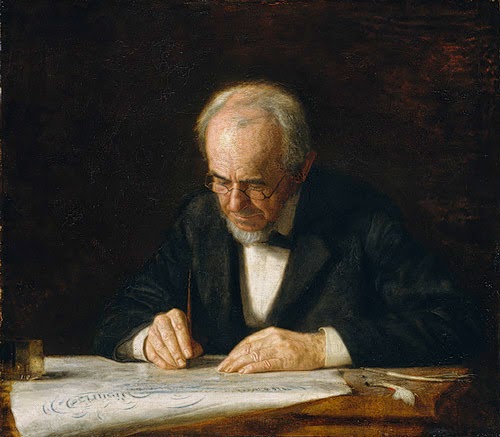 Thomas Eakins, The Writing Master
I know when I sit down for a short writing session, it often morphs into a longer, very productive session where that task I've put off is accomplished. Ten minute increments are great for the short, quick items on your 'to-do' list. Instead of complaining you don't have the time, sit down and do it.
William Zinsser, the famous writing essayist who wrote "On Writing Well, 30th Anniversary Edition: The Classic Guide to Writing Nonfiction " and "Writing To Learn
 ," recommends writing clearly and concisely, eliminating all the flowery flourishes and jargon.
If you don't like these books, I have lots of others with great writing advice, including A Beginning, a Muddle, and an End: The Right Way to Write Writing , a very cute story.
In the end, the best way to hone your writing skills is to write regularly. Try different styles, work your ideas out "on paper." If you cannot get the words to flow on paper or the computer screen, try a recorder. Talk to a friend about your ideas while recording yourself, transcribe your notes, then edit and polish.
PEW Internet Research Project is running a survey between now and the beginning of September.
Are you a library user? Fill out the quiz, contribute to their survey. Here's the Link: PEW Library User Survey
I just read A. Nelson, J. Irwin. "Defining What We Do -- All Over Again": Occupational Identity, Technological Change, and the Librarian/Internet-Search Relationship. Academy of Management Journal, ScienceDaily, 7 Aug. 2013. Web. 16 Sep. 2013
http://www.sciencedaily.com/releases/2013/08/130807134506.htm
In the article, Nelson talks about how librarians and information professionals are redefining themselves as searchers of information particularly in terms of "who we are" and "what we do". I'd like to expand on the two phrases from my point of view as a veteran librarian who has been teaching and working in the field for decades.
Librarians have always defined themselves as those who help others find information, and as a profession that disseminates information. It's important to recognize that we disseminate information. We help get that hidden 'knowledge' out into the hands of researchers, historians, students and teachers, financial planners, investors, and anyone else who wants to know something. To me, that's the key to the job and the profession. Using the internet to find information is great. The internet is now the key for doing research and it is the first step for finding information.
There are other proprietary databases, print resources and indices that are not readily available on the internet. Libraries, archives, and information centers subscribe to these 'fee-based' resources that provide access to other materials not readily available to the general public. As a librarian, it is important to know about these resources and to be able to mine the indices and databases for requested information. Not everything has been digitized and made available online. Public records, corporate records, government records and documents are just some of the types of materials that exist in print form that may never be digitized. Or the indices may be available, but not the actual records. The researcher has to go to the sources to complete his or her project.
While the information on the web proliferates at an astounding rate, librarians and information scientists continue to help those who ask find what they seek. Our job and our field, while it evolves quickly, is rooted in the idea of helping our client base, our patrons, find information. If you keep that in mind, you'll succeed throughout your career in the mind-boggling and ever challenging field of library and information science.
This Foundations course is designed to teach you about the profession and give you a taste for the types of work each type of library / archives / cultural institution entails.
There are four major types of libraries; public, school, academic, and special. There are archives and record centers, historical societies and museums. Special collections and rare book libraries are usually part of academic libraries or museums. When you consider special libraries, those that focus on a specific topic or trade, there are information centers, corporate libraries, law libraries, research centers and think tanks, and more.
Museums have both libraries and collections of objects including art, artifacts, animals, and minerals. Historical societies collect objects, printed materials, and records or manuscripts.
When we delve into the information science side of LIS, there are information centers, usability labs, knowledge management functions and skills, search and retrieval centers, organizations that deal with information, data, metadata, databases, and the accumulation, aggregation, and dissemination of data, big and small.
Within this broad and expanding field there are opportunities to work in tradition jobs, such as reference and cataloging, and non-traditional jobs like scholarly communications and first-year experience. New jobs crop up every day including digital curators and digital humanists, electronic records managers, and human computer interaction specialists.
This ever growing list is just a taste of the professionals and niches out there for LIS students and practitioners. What should you specialize in? I've always felt that general knowledge is best, but over the years I've come to realize that students need strong technology and searching skills, the ability to approach a website or database and determine how to retrieve data using the available access points and limitations. Digital skills are essential these days, even for analog librarians and those who gravitate toward the printed book.
Most of all it is important to explore the various fields and permutations of LIS and determine how your skill set resonates with the required or perceived skills for a practitioner. Explore the field, it is ever changing and challenging, yet holds many opportunities.
Over the past year or so, I've been reading an interesting blog "Hack Library School."
Library science
students talk about their impressions of the field, provide advice for
fellow students, and suggestions on viewing themselves in Hack Library
School http://hacklibschool.wordpress.com/
This blog should be read by professors of LIS and by practitioners who
want to know what students are concerned about. The current post http://hacklibschool.wordpress.com/2013/09/16/things-to-consider-when-applying-to-library-school/ is particularly enlightening as is today's post (Sept 23, 2013) "Working, Volunteering, or Interning Before Library School" http://hacklibschool.wordpress.com/2013/09/23/working-volunteering-or-interning-before-library-school/#more-7885
What type of information professional do you want to be when you grow up?
As we consider the history of libraries, we recognize that many from the ancient world do not survive. In fact, many collections of tablets, stone, and papyrus materials are records that document legal and administrative matters, such as the collections at Ebla, Tel El Amarna, and even the Linear B tablets found in Knossos and Mycenae. There are several wonderful books about the discovery of these collections and the decipherment of their records. The most recent is by Margolit Fox The Riddle of the Labyrinth: The Quest to Crack an Ancient Code which describes the discover of Linear B tablets and their decipherment by Alice Kober and Michael Ventris. These tablets contain annual inventories of goods shipped and received at administrative centers in the ancient world (1800-1400 BCE).
We have all heard about the Library at Alexandria, founded by Ptolemy Soter and expanded by rulers in Egypt, burned by Julius Caesar, expanded by Marc Antony and Cleopatra, burned, expanded, and finally destroyed so that there are no scrolls or codices, merely archaeological ruins buried under the modern city in Egypt. One library that survives and is still being recovered is that at Herculaneum
The city was destroyed when Mt. Vesuvius erupted in 79 CE spewing lava and ash over Pompeii and Herculaneum. Today, using refracted light and much patience, scrolls uncovered in the late 1700s are being digitized and preserved. The National Geographic video describes how the papyrus scrolls are unrolled and read today. http://youtu.be/rQBgoLZZjHM
Down through the ages, libraries have come and gone, some surviving and still in use like the Vatican Library that we discussed, others disappearing, known only through comments in the literature, letters, and historical references. Many of the national libraries today are working separately and jointly to preserve the historical record. The Smithsonian Libraries is one example. Again a very nice marketing video talks about the vast collections at the institution. http://youtu.be/bi75-k-7hrE
How does your library document its history? What does it collect that documents and preserves the history of your community?
There are lots of jobs and careers out there for librarians and information scientists. Researchers and writers are just some of the traditional positions graduates seek. Today I read the blog for Amanda Brenan, graduate of Rutgers, who calls herself a Meme Librarian and haunts forgotten places and files on the web. If you want to know what others with MLIS degrees are doing, check out her blog http://biblioboard.tumblr.com/post/60750440586/when-i-began-library-school-in-2009-i-had-no-idea
As to my career, I've been a researcher, a consultant, a librarian and historian at large, and most of all a teacher. Somehow with all these positions and vocations, I use my degree every single day.
What non-traditional positions are you looking at?
I was thinking about the first week of Foundations of Library & Information Science, where we explored the Ampersand symbol, its meaning, origin, and definition., as we discussed the need to look up symbols, terms, and concepts for library patrons even if we know the answer. On one of the listservs I frequent, there is a posting for an article in the current New Yorker (Sept 6, 2013) about Hashtags, Manicules, and more. The article written by Keith Houston is entitled "Ancient Roots of Punctuation" http://www.newyorker.com/online/blogs/books/2013/09/origins-of-hashtag-manicule-diple-pilcrow-ampersand-explained.html
The article explores the origins of various symbols, including the number sign which can be used as an abbreviation for Pound, or lb. As with Ampersand, I was amazed that I use this symbol frequently and had no idea of its origins. If you are intrigued with the article, you might look at his book Shady Characters: The Secret Life of Punctuation, Symbols, and Other Typographical Marks .
What did you learn today?
.
What did you learn today?
